In European cooperation, we tend to follow a very familiar sequence.
A funding opportunity appears.
An idea starts taking shape.
Potential partners are identified.
A consortium is built.
The proposal is submitted.
And, if everything goes well, a project begins.
There is nothing wrong with this process. It is how thousands of valuable European projects are created every year.
But recently, we have been asking ourselves a different question:
What if the consortium wasn’t the starting point?
Consortia are designed for projects
A consortium has a very specific purpose.
It brings together the organisations needed to deliver a particular project.
One opportunity might require a university, a municipality and organisations capable of reaching specific target groups.
Another might require completely different expertise.
And that’s exactly how it should be.
As we explored in a previous reflection, strong consortia should be designed around what a project actually needs — not around a fixed list of organisations we always work with.
But this creates another question.
If every consortium is temporary and every project requires a different combination of expertise, where does continuity live?
Perhaps we need something between organisations and projects
We are increasingly interested in the idea of alliances.
Not as permanent consortia.
And not simply as a more impressive word for partnerships.
We see an alliance as something different.
A group of organisations that decide there is a challenge, topic or direction they want to explore together over time.
There may be no open call.
No proposal deadline.
Sometimes, not even a project idea yet.
What exists first is a shared direction.
That changes the sequence.
Instead of:
Call → Idea → Partners → Consortium → Project
we can also imagine:
Shared challenge → Alliance → Ideas → Opportunities → Consortia → Projects
The difference may look small.
We think it changes quite a lot.
An alliance doesn’t mean always working with the same partners
This distinction is important.
Building long-term alliances should not mean creating closed circles where the same organisations appear in every project.
Actually, we think the opposite is true.
Every project should still have the consortium it needs.
If an opportunity requires expertise that does not exist within the alliance, new organisations should join.
If a municipality is needed, find the right municipality.
If research capacity is needed, involve the right university.
If access to a particular community is essential, work with an organisation that genuinely reaches that community.
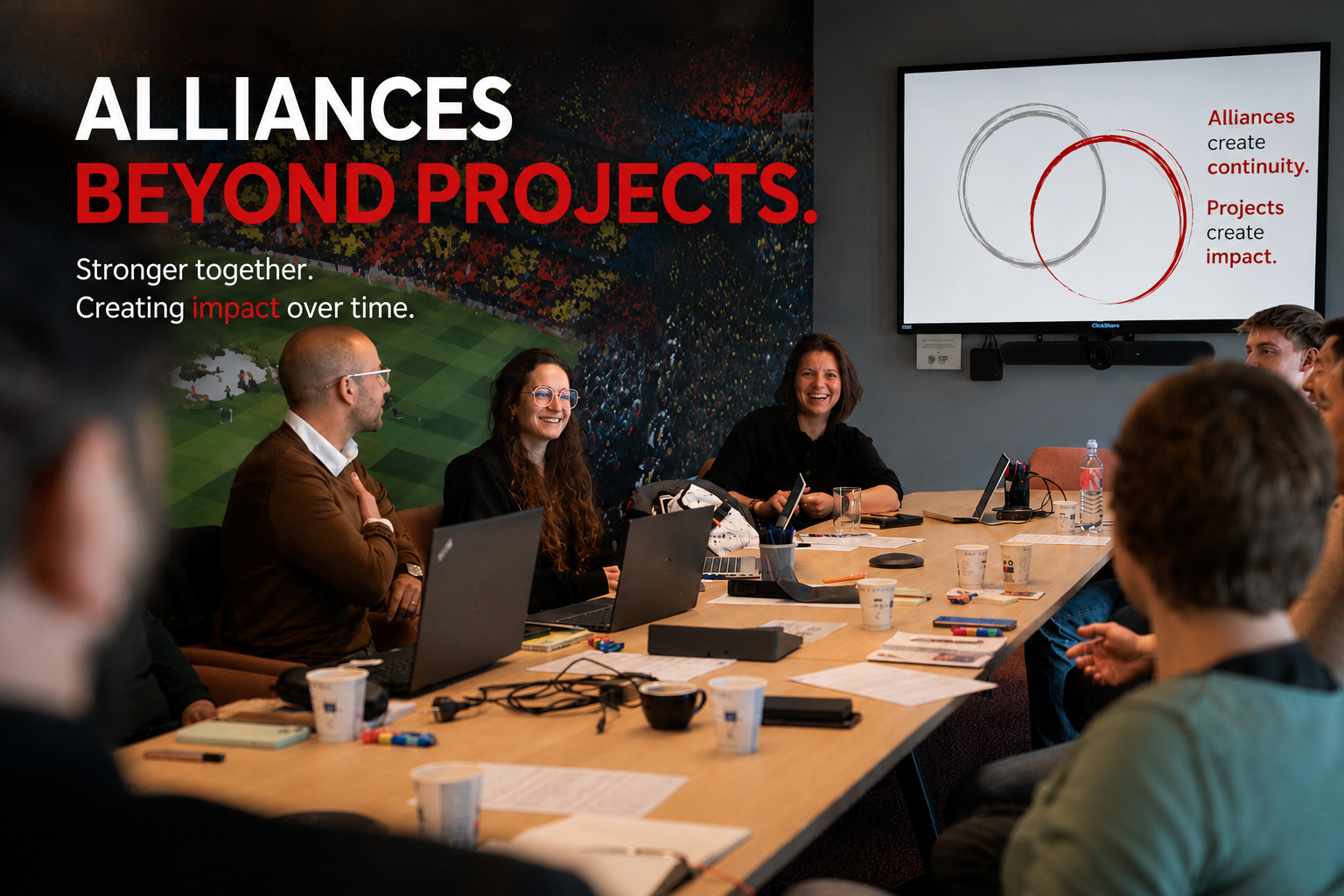
The alliance creates continuity. The consortium creates the right architecture for a specific project.
They serve different purposes.
So what happens when there is no project?
Perhaps this is where the real value of an alliance becomes visible.
Organisations can continue talking.
They can exchange what they are seeing in their countries.
Share emerging challenges.
Explore ideas before they become proposals.
Identify funding opportunities.
Introduce new organisations to one another.
Develop concepts slowly rather than inventing them three weeks before a deadline.
And, perhaps most importantly, understand each other better.
Then, when the right opportunity appears, the conversation doesn’t need to start from zero.
There is already context.
There is already trust.
There is already a shared understanding of where each organisation can create value.
The project becomes an outcome of the relationship rather than the reason for the relationship.
From finding partners to building ecosystems
We are still exploring what this means in practice at L’ORMAinternational.
But it is gradually changing the way we think about international cooperation.
For years, one of the central questions in project development has been:
“Who should we involve in this project?”
That question remains important.
But perhaps another one should come before it:
“Around which challenges do we want to keep building relationships, knowledge and opportunities over the next few years?”
Because once that becomes clear, international cooperation starts looking less like a sequence of disconnected projects.
It starts looking more like an ecosystem.
Projects enter and leave.
Funding programmes change.
Consortia evolve.
New organisations join.
But the direction continues.
Beyond projects
Perhaps this is ultimately what an alliance can provide.
Not certainty about the next project.
Continuity between projects.
A space where organisations can think together before funding appears, build trust before deadlines arrive and develop ideas before they need to become proposals.
And when an opportunity eventually emerges, the objective is not to force the alliance into the project.
It is to build the best possible consortium around that opportunity.
Maybe the goal shouldn’t be to build a new partnership for every project.
Maybe it should be to build alliances capable of generating many projects, collaborations and opportunities over time.
For us, this is increasingly what Structuring Alliances Beyond Projects means.
If your organisation has been reflecting on similar questions, we’d genuinely love to continue the conversation.
Connect with us → https://ormainternational.eu/connectwithus/