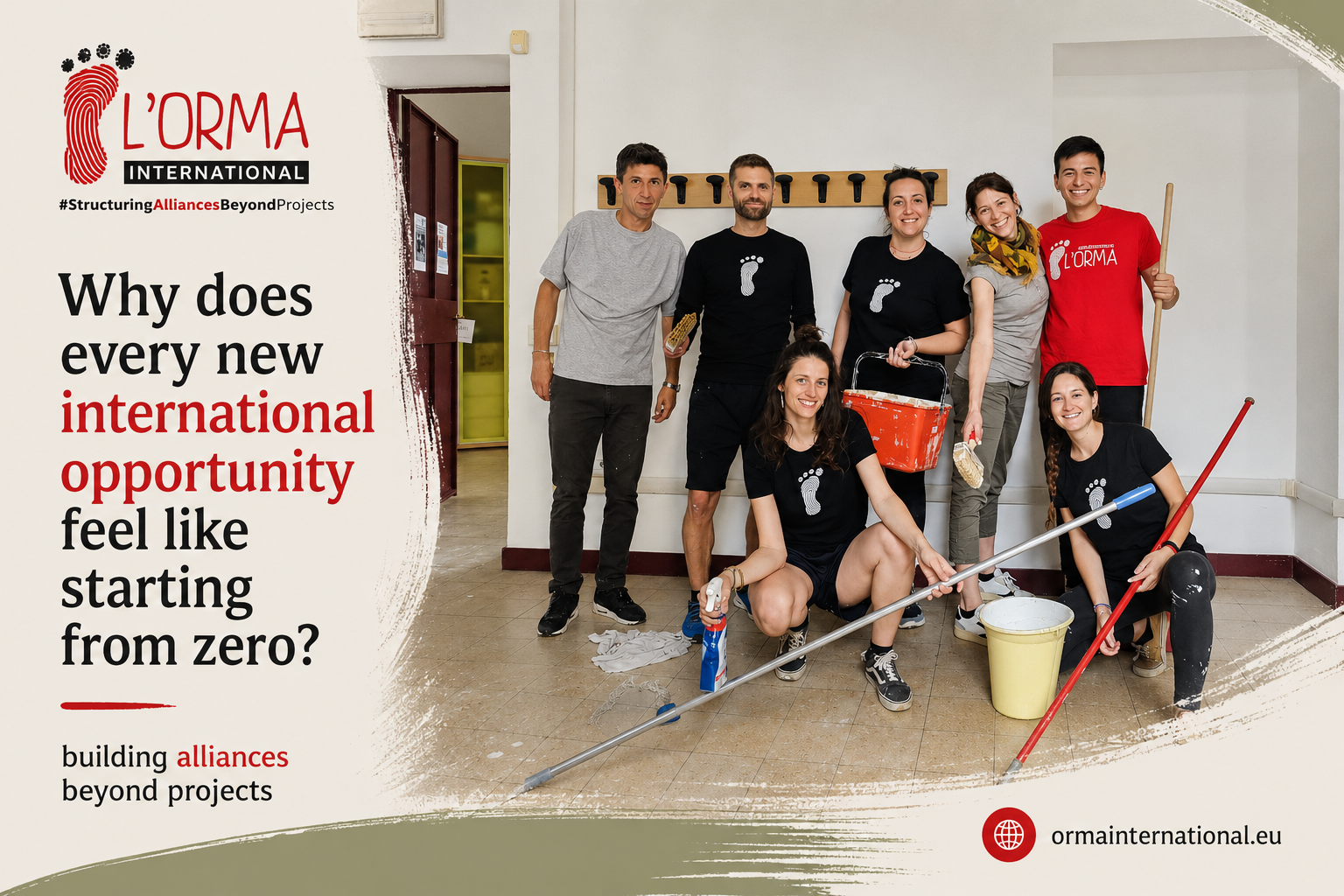
Many organisations active in international partnerships know this feeling.
A new opportunity appears.
A conversation starts.
Potential partners are contacted.
Roles are explored.
Alignment begins.
And despite previous experience, the process can feel surprisingly familiar.
Almost like starting from zero.
New conversations.
New explanations.
New trust to build.
This raises an interesting question:
Should international collaboration really feel this fragmented?
In theory, organisations that have already worked internationally should naturally benefit from the experience they have accumulated over time. Existing relationships should make conversations easier. Previous collaborations should create trust. Positioning should become clearer. In short, each international experience should make the next one a little stronger.
And yet, this is not always what happens.
Many collaborations remain closely tied to individual projects. Relationships become active when a specific opportunity emerges, intensify during proposal development or implementation, and then gradually lose momentum once the project ends.
So when the next opportunity appears, organisations often find themselves restarting much of the same relational work: reopening conversations, rebuilding alignment, recreating trust.
Not necessarily because anything went wrong.
But simply because continuity was never intentionally built into the way collaboration happens.
The hidden cost of fragmented international partnerships:
This dynamic creates invisible costs.
Time spent restarting conversations.
Energy spent rebuilding trust.
Effort spent recreating momentum.
And perhaps most importantly: lost strategic advantage.
Because experience should not only create knowledge.
It should create stronger collaboration infrastructure over time.
A question for international partnerships
Not every partnership needs to become long-term.
Flexibility matters.
Different projects require different expertise.
But there is an important difference between flexibility and fragmentation.
As international collaboration becomes more competitive, one question feels increasingly relevant:
How do organisations create continuity between opportunities, instead of repeatedly starting from scratch?
That may be one of the most important strategic conversations international organisations can have.
If your organisation is also reflecting on these kinds of international collaboration dynamics, we are always happy to connect with like-minded organisations exploring stronger long-term pathways.
Connect with us → https://ormainternational.eu/connectwithus/