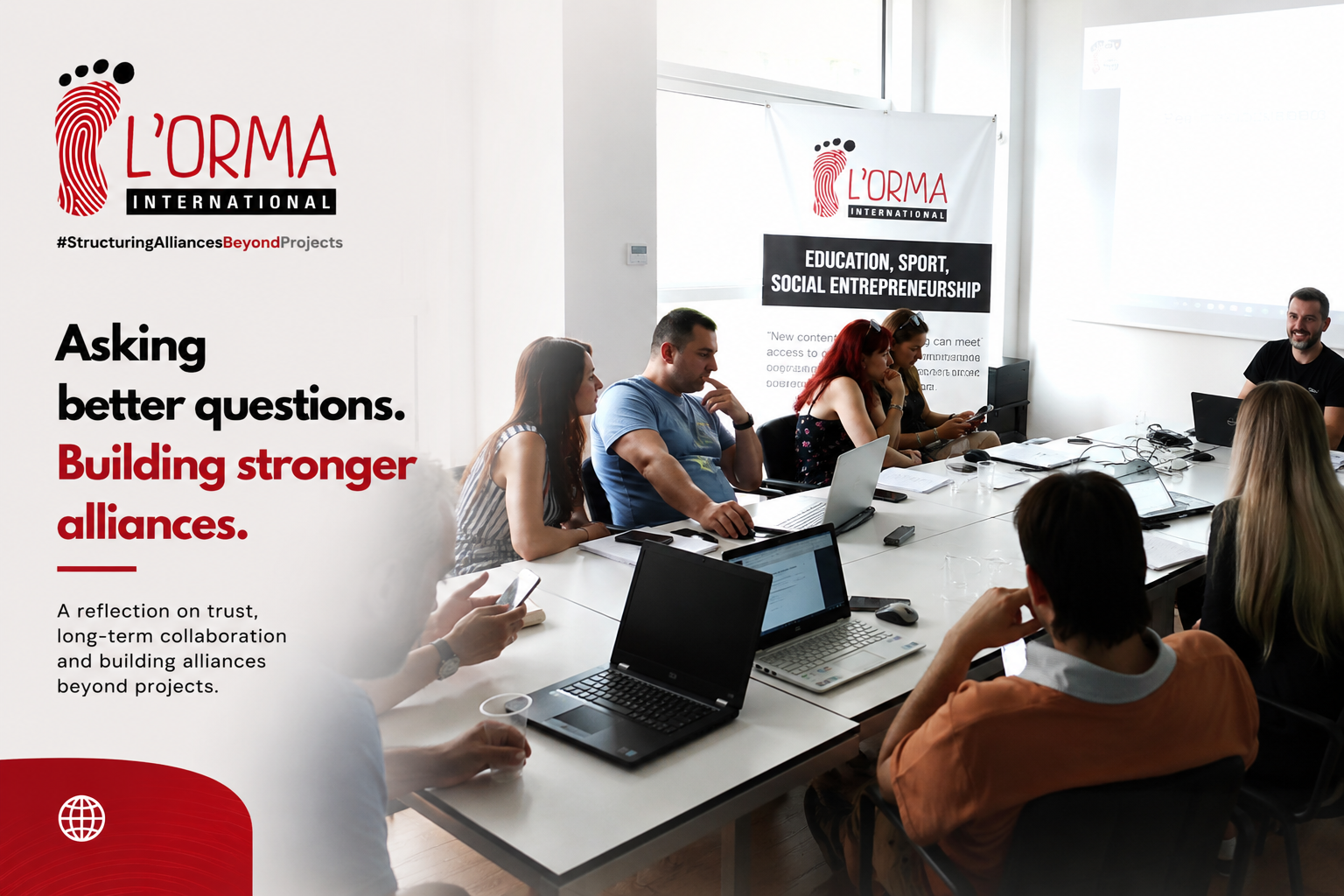
A few days ago, our team at L’ORMAinternational was reviewing a new funding opportunity.
Like many organisations do, we started discussing potential partners.
Who has experience in this field?
Who could add real value?
Who might already be working on something similar?
Who should we contact first?
It was a completely normal conversation. In fact, we’ve probably had it dozens of times over the years.
Then someone asked a question that changed the direction of the discussion.
“Why do we always start by looking for partners?”
Not because finding the right partners isn’t important.
Of course it is.
But perhaps that isn’t where international collaboration really begins.
That question stayed with us long after the meeting had ended.
Looking back instead of looking ahead
Over the following days, we started reflecting on the organisations we consider our closest international partners today.
Some of them have collaborated with us on several projects.
Others only on one.
Interestingly, the number of projects wasn’t what they had in common.
What they shared was something else.
The relationship had continued to grow even when there wasn’t a project to work on.
We kept exchanging ideas.
Sharing opportunities.
Introducing each other to new people.
Talking about challenges.
Sometimes simply catching up over a coffee during an international event.
Looking back, we realised that those relationships hadn’t been built during proposal writing.
Projects had strengthened them, certainly.
But they hadn’t created them.
Maybe we’ve been thinking about partnerships the wrong way
Preparing a consortium often feels like the starting point of international collaboration.
Perhaps it isn’t.
Perhaps it’s simply one moment within a much longer relationship.
When organisations only reconnect because a new funding opportunity appears, collaboration risks becoming transactional.
The project becomes the reason to talk.
The deadline becomes the reason to reconnect.
The final report becomes the end of the conversation.
We are starting to wonder whether this is one of the reasons so many organisations feel they are constantly starting from zero.
A different question
Recently, we’ve found ourselves asking a different question.
Instead of asking:
“Who do we want in our next project?”
we’ve started asking:
“Who do we want to keep building with over the next five or ten years?”
It’s a subtle difference.
But it changes almost everything.
Because it shifts the focus from projects to relationships.
From short-term collaboration to long-term trust.
From finding partners to building alliances.
What we’re trying to build
This reflection is also changing the way we think about L’ORMAinternational.
We still care deeply about developing strong international projects.
That hasn’t changed.
What is changing is what happens between those projects.
We’re trying to spend more time understanding what other organisations are building.
More time exchanging ideas without immediately thinking about funding.
More time staying connected simply because we enjoy learning from one another.
We’re still figuring out what this looks like in practice.
We certainly don’t have all the answers.
But we’re increasingly convinced that some of the most valuable conversations happen when there isn’t a proposal to write.
Building Alliances Beyond Projects
Over the last few months, we’ve been reflecting a lot on what kind of international organisation we want to become.
The conclusion we’re slowly arriving at is surprisingly simple.
Projects matter.
They create impact.
They bring people together.
But they shouldn’t be the only reason organisations stay connected.
The relationships we value most today are not defined by a single consortium or a single grant.
They are defined by continuity.
By trust.
By the willingness to keep building something together, even when there is no immediate opportunity on the table.
For us, this is what Building Alliances Beyond Projects really means.
Not a slogan.
A direction.
One that we are still exploring, learning from and, hopefully, building together with organisations that share the same mindset.
If your organisation has been reflecting on similar questions, we’d genuinely love to continue the conversation.
Connect with us → https://ormainternational.eu/connectwithus/